
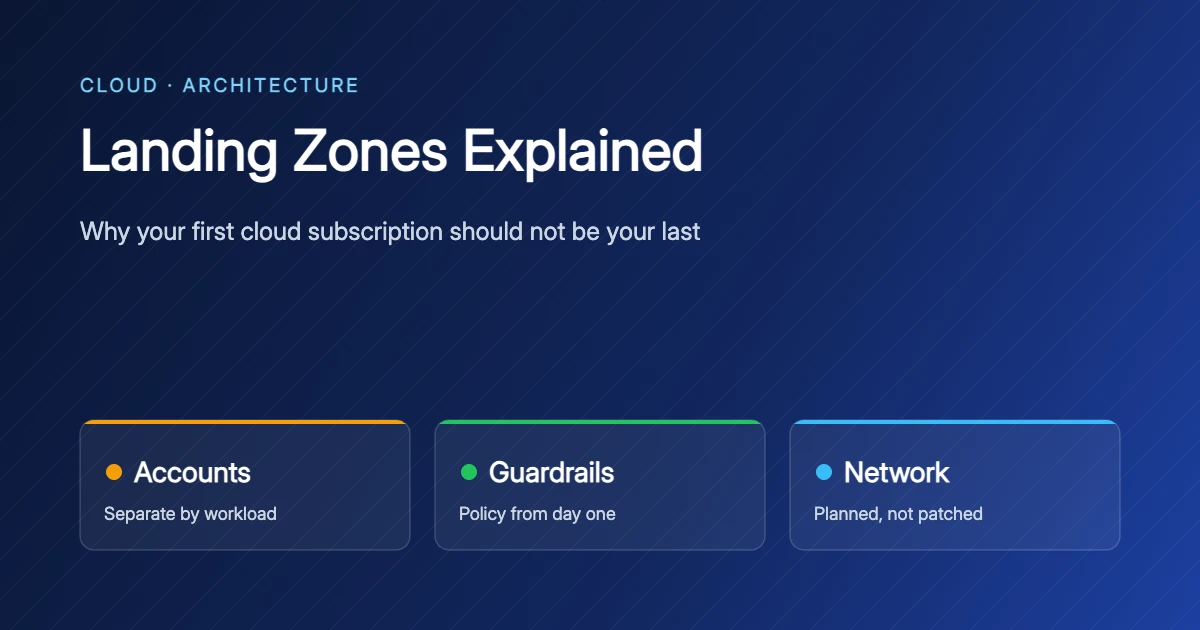
Spinning up your first cloud subscription takes about ten minutes. You swipe a card, name a resource group, deploy a container, and it works. Six months later that same account holds production databases, a half-finished staging environment, three people’s experiments, and a billing report nobody can read. This piece explains what a landing zone is, why that first subscription turns into a liability, and how to build a foundation that grows with you instead of against you.
It is written for teams that have moved past the proof of concept and are now running workloads that matter. You do not need a platform engineering department to apply any of it. You do need to stop treating cloud structure as something to clean up later, because later rarely arrives on its own.
What a landing zone actually is
A landing zone is a pre-configured cloud environment, built across several accounts or subscriptions, with identity, networking, security baselines, and governance in place before a single workload arrives. Think of it as the wiring, plumbing, and fire doors of a building rather than one open room you keep cramming furniture into. AWS calls its version Control Tower, Azure ships Landing Zone accelerators, and Google Cloud has its own landing zone framework, but the idea is the same across all three.
The point is to decide how your environment is organized once, in a repeatable way, so every new project drops into a known structure. A well-built landing zone separates production from development, isolates sensitive data, and applies the same security rules automatically to anything that lands inside it. Nobody has to remember the rules, because the environment enforces them.
The one-subscription trap
One subscription becomes a trap because everything you build piles into the same blast radius. When production, staging, and a developer’s weekend experiment share one account, a single over-permissioned credential or a misconfigured storage bucket exposes all of it. Identity sprawls, roles accumulate, and before long nobody can say with confidence who can touch what.
This is not a rare edge case. Gartner’s often-quoted forecast held that, through 2025, 99 percent of cloud security failures would be the customer’s fault rather than the provider’s, and most of those trace back to configuration the customer owns. A landing zone pushes those configuration decisions to the front, where they are deliberate instead of accidental, and bakes them into the structure so new teams inherit them for free.
Not every business keeps cloud engineers on staff to design that structure. A company in that position can lean on Contigo’s managed IT deployment to lay out the account hierarchy, identity model, and guardrails before the first real workload ships, which costs far less than untangling the whole thing after it has grown roots.
Identity, networking, and the blast radius problem
Identity and networking are the two layers that decide how much damage one mistake can do. In a flat single-subscription setup, a single network usually means lateral movement is trivial: compromise one service and the rest are a short hop away. A landing zone gives each environment its own network boundary and its own identity scope, so a breach in a sandbox account cannot reach the production database.
Structure on its own does not keep a landing zone healthy, though. Configurations drift, permissions get granted in a hurry and never revoked, and alerts stack up until someone stops reading them. The environment needs proactive tech support keeping an eye on it to catch those problems before they turn into an outage or a surprise invoice.
The stakes here are not abstract. IBM’s 2024 Cost of a Data Breach report put the global average breach at $4.88 million, up 10 percent on the year before and the largest jump since the pandemic. A good share of that cost comes from how far an incident spreads inside an environment, which is exactly what account separation is built to contain.
Governance and cost come before scale
Governance is what keeps a growing cloud estate from quietly draining money. Without tagging rules, budget alerts, and clear ownership assigned per account, spend creeps and nobody notices until the invoice lands. Flexera’s State of the Cloud research found that organizations estimate they waste around 29 percent of their cloud spend on infrastructure and platform services, a figure that has barely moved in five years of companies trying to fix it.
A landing zone makes cost visible by design, because each team or project sits in its own account with its own budget and its own tags. When spending spikes, you can see which workload caused it in minutes instead of reverse-engineering a single combined bill. Guardrails written as policy also stop expensive mistakes early, blocking an oversized instance type or a resource in the wrong region before it ever runs.
Make the tagging scheme a standard, not a suggestion. Decide on a small, mandatory set of tags before anyone deploys: cost center, environment, owner, and data classification, enforced by policy so an untagged resource simply does not launch. Pair that with per-account budgets that fire an alert at, say, 80 percent of the monthly limit and a hard action at 100 percent, whether that action is a notification to the owner or an automated freeze on new resources. Four tags and two thresholds turn a mystery bill into a map.
Governance sounds like bureaucracy until the first time it saves you. A policy that denies public storage buckets by default is not slowing anyone down; it is removing one of the most common ways companies leak data to the open internet.
A practical path from one subscription to many
To move from one subscription to a landing zone, start with structure, not a full rebuild. You do not have to tear down what you have and begin again over a long weekend. You split it apart in a sensible order and codify each step as you go.
Begin by carving production into its own account so a mistake in development can never reach it. Next, stand up a dedicated account for identity and billing, keeping the keys to the kingdom away from day-to-day workloads. Then write your guardrails as policy, using service control policies or their Azure and Google equivalents, so the rules apply automatically rather than relying on anyone’s memory. Finally, put the whole arrangement into infrastructure as code with a tool like Terraform, so the next account your team needs is a reviewed pull request instead of an afternoon of clicking through a console.
A workable baseline is a small set of foundational accounts that nearly every landing zone shares. Keep a management account at the root for organization-wide policy, a log archive account that collects audit trails from everywhere and lets no one delete them, a security account where your detection tooling reads across the estate, and a shared-services account for networking and DNS. Workload accounts then hang off that spine, one per application and environment. Send every log to the archive account on day one, because reconstructing an incident without immutable logs is close to impossible.
That last step is the one most teams skip and most regret skipping. Once account creation is codified, a new project gets a fully governed environment in minutes, with logging, networking, and security baselines already wired in. The structure scales because it was never hand-built in the first place.
Conclusion
Your first cloud subscription is a fine place to start and a terrible place to stay. It teaches you the platform, it ships your early work, and it quietly accumulates the risk and cost that a landing zone exists to prevent. The teams that pull ahead are the ones that treat account structure, identity, and guardrails as foundational engineering rather than cleanup work for a quieter month that never shows up. If you do one thing this quarter, carve production into its own account and switch on centralized logging; those two moves alone shrink your blast radius and give you a record to investigate when something goes wrong. Draw the blueprint early, codify it, and let every new workload land somewhere that was ready for it.
